AnalogLore
Playlists
Search
Vault
Playlists
Search
Vault
arrow_back
All playlists
SSCD IIT Kanpur
·
Basic Analog Building Blocks
·
57 videos
EE610: Analog IC design-1 (2025)
Original playlist on YouTube
arrow_outward
Videos in this playlist
Lec 1(1): Why non-linear ckts? 1-port amp. I-V char; operating point & small-signal linear eq. ckt
View
Lec 1(2): I-V char. of 2-port non-linear network to work as an amp.; Small-signal linear circuit
View
Lec 2(1): A 45 minute recap/intro to MOSFET: from the point of view of building analog circuits
View
Lec 2(2): Common-source amplifier: Biasing the transistor
View
Lec 3(1): Constant-voltage biasing for a common-source amplifier
View
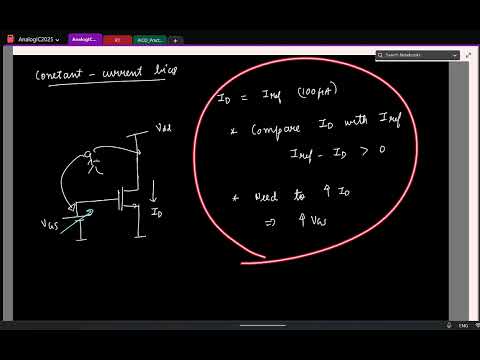
Lec 3(2): Motivation for constant-current biasing; Drain and source feedback
View
Lec 4(1): Biasing common-source amplifier with source feedback; pMOS common-source amplifier example
View
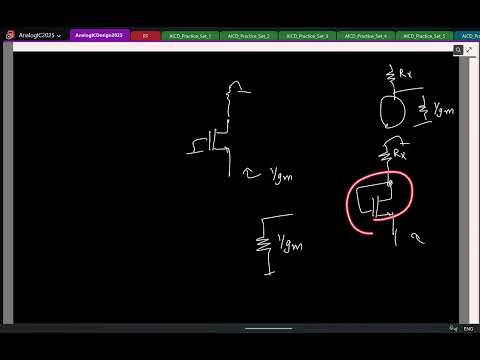
Lec 4(2): Common-drain and common-gate; Resistance looking into the source of a transistor
View
Lec 5: Evolution of differential amplifier (from common-source to 5-transistor amplifier)
View
Lec 6(1): Cascode current source; Recap of some common impedances
View
Lec 6(2): The 5-transistor amplifier: DC operating point
View
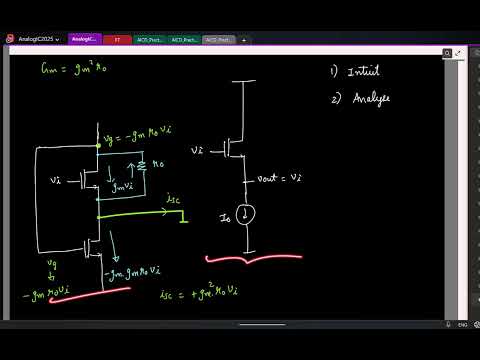
Lec 6(3): The 5-transitor amplifier: Output resistance & Short-circuit transconductance
View
Lec 7(1): 5-transistor differential amplifier: Is it really an opamp?
View
Lec 7(2): The 5-T OTA: Common-mode gain & differential mode gain
View
Lec 7(3): The 5-T OTA: Resistance looking into different nodes
View
Lec 7(4): Relevance on the range for input common-mode and output
View
Lec 8(1): Input common-mode range & output swing limits in the 5-T OTA
View
Lec 8(2): How to learn & analyze analog circuits? eg of flipped & super source follower
View
Lec 9(1): Difference between a VCVS and VCCS in negative feedback
View
Lec 9(2): Understanding slewing & slew rate in the 5-T OTA
View
Lec 9(3): Introduction to telescopic cascode
View
Lec 9(4): Discussion of a couple of example problems
View
Lec 10(1): Telescopic cascode, high-swing cascode: Input common-mode range & output swing limits
View
Lec 10(2): Deriving the telescopic cascode
View
Lec 10(3): Folded cascode: swings in unity feedback & advantages over telescopic cascode
View
Led 11(1): Gain-boosted cascode
View
Lec 11(2): Poles in circuit: When can pole locations be guessed by inspection?
View
Lec 12(1): Poles in a circuit: When can poles be guessed by inspection?
View
Lec 12(2): Zeros in a circuit
View
Lec 12(3): Example of an uncontrollable/unobservable state
View
Lec 12(4): Finding poles & zeros in a common-drain structure by inspection
View
Lec 12(5): Poles & zeros in common-source structure; Intro to Miller effect
View
Lec 13(1): Can Miller effect be used to find high-freq pole? intuition for pole locations
View
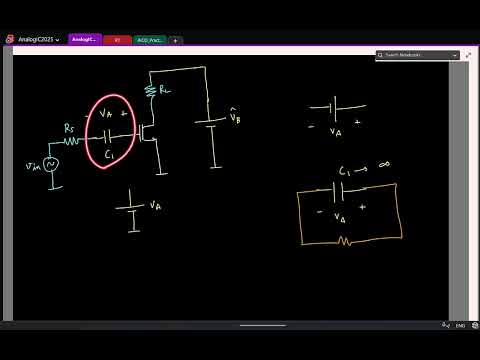
Lec 13(2): Poles & zeros due to the ac coupling capacitors used for biasing
View
Lec 14(1): Poles in 5-T OTA; Zeros in differential-mode transfer function
View
Lec 14(2): Poles & zeros in cascode and telescopic cascode
View
Lec 14(3): Motivation for multi-stage OTAs
View
Lec 15(1): Need for DC negative feedback in opamps/OTAs
View
Lec 15(2): Finding the signs of opamp for negative feedback
View
Lec 15(3): Discussion of few problems
View
Lec 16(1): A 25 min recap of the course...
View
Lec 16(2): Does negative feedback reduce output resistance? Types of negative feedback
View
Lec 16(3): First-order system in negative feedback; Unity loop gain freq. & closed-loop bandwidth
View
Lec 17: Understanding frequency compensation via Root Locus; Phase margin; LHP zero vs. RHP zero
View
Lec 18: Miller compensation; Two-stage Miller compensated OTA; Rough design example
View
Lec 19(1): Miller compensation: Eliminating the RHP zero
View
Lec 19(2): Two-stage feedforward compensation
View
Lec 20(1): Nested Miller & Feedforward compensation
View
Lec 20(2): Pseudo diff. vs. fully diff. ckts; Need for common-mode feedback in fully diff. ckts.
View
Lec 21: Common-mode feedback (CMFB) choices & design considerations; 2-stage Miller OTA with CMFB
View
Cadence demo: Systematic design of a two-stage Miller OTA & tackling the gate parasitic capacitance
View
Lec 22(1):Two-stage feedforward OTA with current re-use; Common-mode rejection due to CMFB
View
Lec 22(2): Process variation & random mismatch; Pelgrom's model
View
Lec 24: Input referred noise voltage & current calculations; Noise & Offset in 5-T OTA
View
Lec 25: Noise in fully-diff amp; Noise-power trade-off in analog circuits; Noise scaling & FoM
View
Lec 26(1): Course summary
View
Lec 26(2): Analog layout basics; what to do post schematic design? Concluding remarks
View