AnalogLore
Playlists
Search
Vault
Playlists
Search
Vault
arrow_back
All playlists
SSCD IIT Kanpur
·
Basic Analog Building Blocks
·
43 videos
EE210: Analog Electronics - 2023-24
Original playlist on YouTube
arrow_outward
Videos in this playlist
Lecture 1: Substitution theorem revisited
View
Lecture 2: Derivation of Thevenin's theorem
View
Lecture 3a: How can we ascertain if a source inside a black box is voltage or a current source?
View
Lecture 3(b): Ascertaining the type of source inside a box
View
Lecture 4: Linearizing a non-linear element
View
Lecture 5: Incremental analysis with generic non-linearity
View
Lecture 6: Developing a generic framework for small signal equivalent
View
Lecture 7: Requirement of non-linearity for power amplification
View
Lecture 8: Introduction to non-linear two port network
View
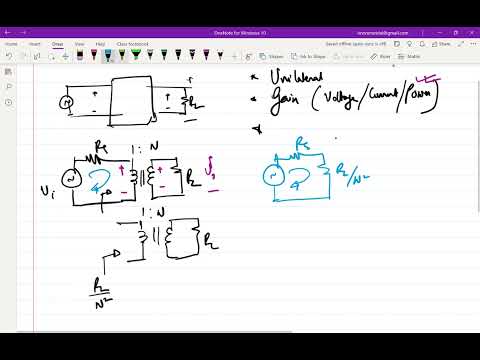
Lecture 9: Desirable characteristics of two-port incremental network for amplification
View
Lecture 10: Desirable I-V characteristics of a non-linear two port for amplification
View
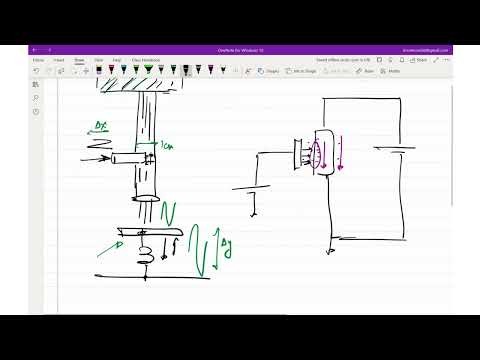
Lecture 11: Relating a mechanical amplifier to an electronic counterpart
View
Lecture 12: Evolution of a device needed for amplification
View
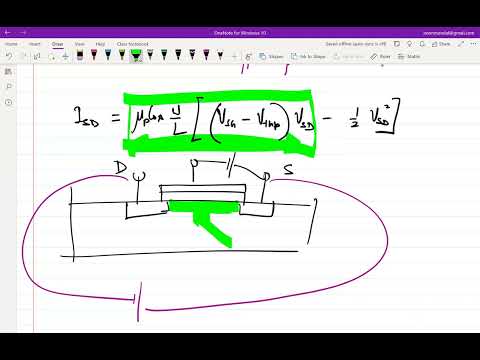
Lecture 13: Introduction to the I-V char of a p-MOSFET
View
Lecture 14: Introduction to the small-signal model of a p-MOSFET
View
Lecture 15: Various regions of operation of a P-MOSFET
View
Lecture 16a: Biasing a P-MOSFET in saturation region and application of incremental input
View
Lecture 16b: Biasing a P-MOSFET in saturation contd...
View
Lecture 17: A basic amplifier topology using a PMOS transistor
View
Lecture 18: Use to a capacitor to replace a floating battery for biasing
View
Lecture 19: Finding the values of the capacitances to be used in a common source amplifier
View
Lecture 20: Introduction of an NMOS transistor and its similarities with the PMOS device
View
Lecture 21: Introduction to constant current biasing
View
Lecture 22: Constant current source biasing
View
Lecture 23: Constant current bias, by applying current at the source.
View
Lecture 24: Using a constant current source to bias a transistor
View
Lecture 25: Design of controlled sources using MOSFETs
View
Lecture 26: Synthesis of a common-drain and a common-gate configuration
View
Lecture 27: Channel length modulation in MOSFET
View
Lecture 28: Use of a current buffer to improve voltage gain; Introduction to body effect
View
Lecture 29: Use of a current buffer (Common gate config) contd..
View
Lecture 30: Introduction to current mirrors and the effect of channel length modulation
View
Lecture 31: Cascode current mirrors
View
Lecture 32: Wide-swing current mirror
View
Lecture 33: Designing an amplifier using negative feedback
View
Lecture 34: Introduction to differential amplifier for use in negative feedback loop
View
Lecture 35: Loop gain of a negative feedback loop using a differential amplifier
View
Lecture 36: Differential amplifier with current mirror load
View
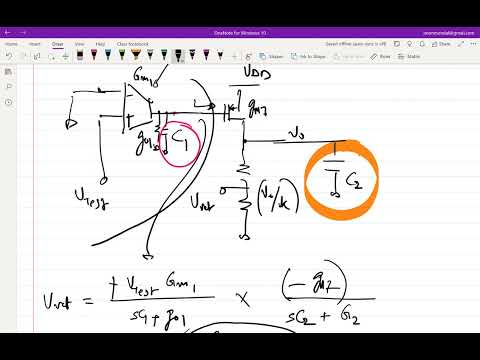
Lecture 37: Capacitances in a MOS transistor and its effects on amplifier
View
Lecture 38: Relation between open loop gain and the the closed loop response
View
Lecture 39: Relating the damping factor of a second order closed loop system to phase margin of L(s)
View
Lecture 40: Loop gain of two stage amplifier and its impact on stability
View
Lecture 41: Stability of two stage opamps and introduction to Miller compensation
View