AnalogLore
Playlists
Search
Vault
Playlists
Search
Vault
arrow_back
All playlists
SSCD IIT Kanpur
·
Basic Analog Building Blocks
·
44 videos
EE 210: Microelectronics I, 2022
Original playlist on YouTube
arrow_outward
Videos in this playlist
Lecture 1: Use of Taylor series to deal with devices having non-linear I-V characteristics
View
Lecture 2: Relating incremental model of a diode with its operating point.
View
Lecture 3: Relating the small signal equivalent to the tangent of the I-V characteristics
View
Lecture 4: Can an LTI network generate power gain?
View
Lecture 5: Requirement of non-linearity for power amplification
View
Lecture 6: Network theory; revisiting KCL, KVL, substitution theorem
View
Lecture 7: Network theory; Thevenin's theorem, source substitution, Tellegen's theorem
View
Lecture 8: Proof of reciprocity theorem; introduction to two-port network
View
Lecture 9: Necessary y-parameter conditions for amplification
View
Lecture 10: An elementary introduction to physics of semiconductor devices; PN junction diode
View
Lecture 11: Introduction to MOS structure
View
Lecture 12: Introduction to MOSFET structure
View
Lecture 13: Introduction to I-V characteristics of in a MOSFET, and its relation with y-parameters
View
Lecture 14: Use of MOSFET in saturation region for amplification
View
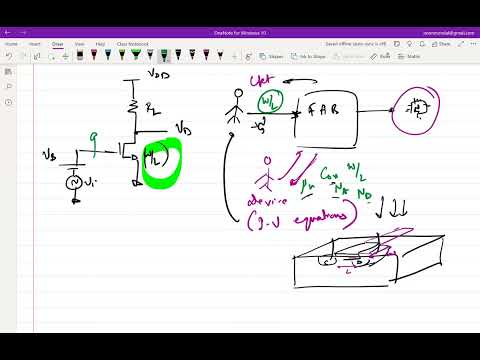
Lecture 15: Synthesis of an amplifier while taking biasing into account
View
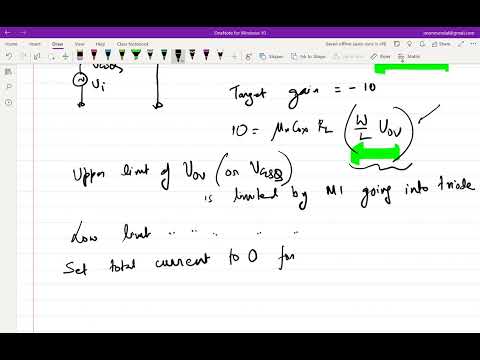
Lecture 16: Swing limits in a common source amplifier
View
Lecture 17: Biasing a common source amplifier for maximum input swing
View
Lecture 18: Replacing a battery with a capacitor to bias a common source amplifier
View
Lecture 19: Finding the component values to bias a the input of a common source amplifier
View
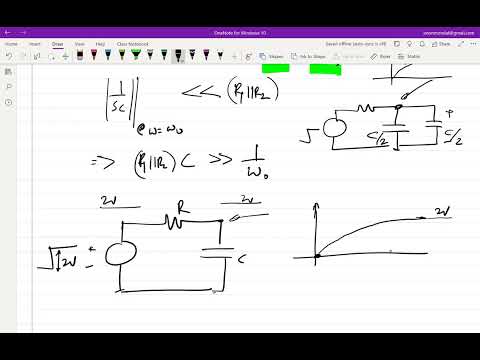
Lecture 20: Using coupling capacitor to drive a load without affecting bias points
View
Lecture 21: Bode plot for common source amplifier; Introduction to constant current biasing.
View
Lecture 22: Constant current biasing; diode connected transistor
View
Lecture 23: Constant current bias, by applying current at the source; evolution of a voltage buffer
View
Lecture 24: Source follower architecture
View
Lecture 25: Introduction to current mirrors to bias a transistor with constant current
View
Lecture 26: Biasing a transistor by pushing current into the drain tweaking the source
View
Lecture 27: Biasing a transistor with current sources contd..
View
Lecture 28: Synthesis of current controlled current source- Common Gate configuration
View
Lecture 29: Channel length modulation in MOSFET
View
Lecture 30: Use of a current buffer to improve voltage gain; Introduction to body effect
View
Lecture 31: Effect of channel length modulation on current mirrors
View
Lecture 32: Synthesis of a stable gain network using negative feedback
View
Lecture 33: Synthesis of a differential amplifier to realize an error amplifier in a feedback loop.
View
Lecture 34: Relating a differential amplifier in feedback to a classical negative feedback topology
View
Lecture 35: Introducing a PMOSFET to realize a gain stage
View
Lecture 36: Common source amplifier with active load
View
Lecture 37: Differential amplifier with current mirror load
View
Lecture 38: Introducing two stage amplifiers and parasitic capacitances
View
Lecture 39a: Differential amplifier contd..
View
Lecture 39b: Role of parasitic impedances in stability of a two stage differential amplifier
View
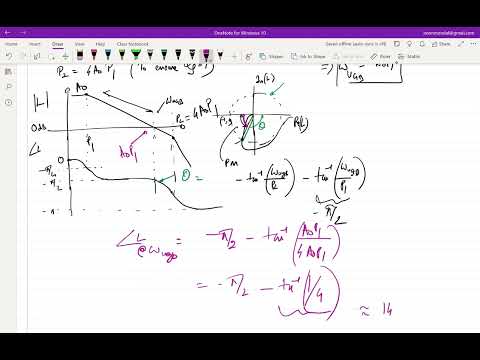
Lecture 40: Compensating a two stage amplifier by making one pole dominant.
View
Lecture 41: Frequency compensation of two stage opamp
View
Lecture 42: Miller Compensated opamp contd..
View
Lecture 43: Critical differences of BJTs with MOSFETs and analog circuit design using BJTs
View